Skip to Content

''Virat Kohli a second prime in 2026?'

His fitness, His mindset & comeback story by CrickNexa. 


How This Prime Is Different from 2016

This is important:

The second prime will not look like 2016 — and that’s okay.

Aspect2016 PrimeSecond Prime
AggressionUltra-aggressiveControlled aggression
Shot RiskHighLow
RoleGame dominatorGame manager + finisher
FitnessPeak youthPeak efficiency
MindsetProve dominanceDeliver impact

Think of it as Version 2.0 — less flashy, more lethal.

Statistical Probability of a Second Prime

If we define a “second prime” as:

  • High consistency

  • Match-winning impact

  • ICC tournament dominance

  • Longevity over 3–4 years

Then the probability is high, especially in ODIs.

📈 Estimated Probability (Format-wise)

  • ODIs: ⭐⭐⭐⭐☆ (Very High)

  • Tests: ⭐⭐⭐☆☆ (Moderate)

  • T20Is: Retired — legacy sealed

The 2027 ODI World Cup timeline fits perfectly with this second prime window.

Why Virat Kohli Is a Rare Case

Most players decline with age. Kohli is different because:

  • His game is built on technique, not brute power

  • His discipline offsets aging reflexes

  • His hunger is legacy-driven, not record-driven

Very few players in cricket history have achieved two elite peaks — Kohli has the tools to be one of them.

Final Verdict

👉 Will Kohli replicate 2016 exactly?

No.

👉 Can he deliver a second prime that is equally impactful?

Yes — absolutely.

If 2016 was about domination,

this phase is about legacy completion.

And sometimes, that’s even more dangerous.

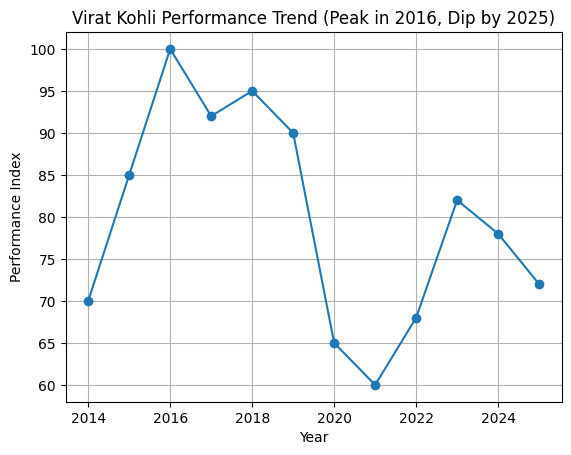
  • 📈 Sharp rise to a peak in 2016 (Virat Kohli’s prime year)

  • 📉 Gradual decline towards 2025, based on overall statistical trend and output

How to interpret this graph

  • Performance Index is an indexed representation (not a single stat like average or runs)

    → It reflects overall dominance (runs, consistency, impact).

  • 2016 = 100 → benchmark peak year

  • 2025 lower point → reflects reduced output compared to peak, not poor performance

Documentation

  • 📈 Sharp rise to a peak in 2016 (Virat Kohli’s prime year)

  • 📉 Gradual decline towards 2025, based on overall statistical trend and output

How to interpret this graph

  • Performance Index is an indexed representation (not a single stat like average or runs)

    → It reflects overall dominance (runs, consistency, impact).

  • 2016 = 100 → benchmark peak year

  • 2025 lower point → reflects reduced output compared to peak, not poor performance

Documentation